

The frozen food industry has grown in significance to restaurants, food manufacturers, hotels, catering food service, institutional kitchens, distributors and retailers. Convenience of preparation is but part of the requirement for commercial buyers. Product sourcing, processing, packaging, cold chain, and consistency are all important. Hence, it makes a lot of sense for businesses looking at frozen vegetables exporters in India to be aware of the entire farm to frozen vegetable distribution process.
India is an agricultural country with a diverse crop base, producing a variety of vegetables with a wide range of applications, both for domestic use and for export. These vegetables have now become possible using modern IQF technology to give them a convenient frozen product for different commercial needs.
Why Food Businesses Rely on Frozen Vegetables Exporters in India
An association with the seasoned frozen vegetables exporters in India can enable businesses to procure the frozen ingredients as per product, quantity, packing and application needs.
Vegetables may be needed by restaurants and caterers that require minimized preparation. Food manufacturers may need to have a uniform format of the ingredients for production, whereas distributors and retailers may need food products that can easily travel through the frozen supply chain.
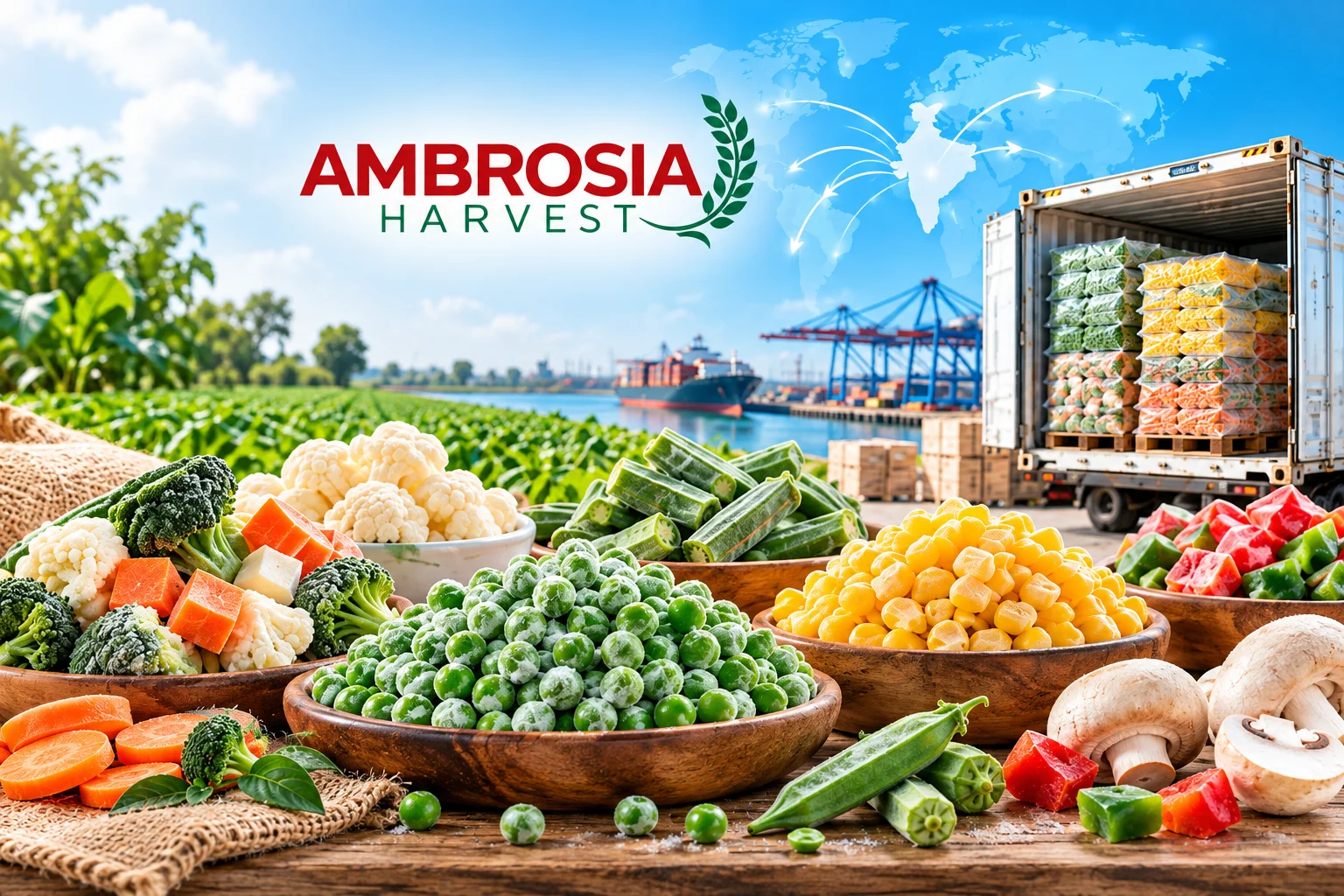
Ambrosia Harvest is the agricultural expertise and the portfolio of IQF frozen-food products for various commercial uses. These include the vegetables like frozen green peas, sweet corn, cauliflower, carrots, okra, capsicum, mushrooms and mixed vegetables.
Understanding IQF Processing
IQF is a term describing Individually Quick Frozen. The process rapidly freezes individual pieces, as opposed to an entire quantity being frozen into one solid piece.
The frozen format can help to portion and handle frozen vegetables in commercial kitchens. For instance, a restaurant can take away a set amount, ensuring the remaining product is stored at or below the recommended temperature.
Sourcing, sorting, cleaning and preparation, controlled blanching (where appropriate), quick freezing, inspection, packaging and frozen storage are all possibilities in the overall process.
Factors to be considered while comparing the frozen vegetables exporters in India, therefore, are beyond the packaged product and the preparation and handling methods of the product.
Why Agricultural Sourcing Comes First
The quality of frozen foods starts with the vegetables themselves when they enter a food processing plant. Fresh produce must be properly sourced, selected, washed and blanched prior to freezing.
For commercial buyers sourcing experience is relevant, because of the link between agriculture and processing.
Ambrosia Harvest has been in agriculture and beekeeping since 1997, and currently carries on with its activities in the premium IQF frozen vegetables and fruits in addition to honey.
When looking into frozen vegetables exporters in India, understanding a supplier’s farming background can offer more insight into the product’s journey.
A Wide Range of Applications for Businesses
Various vegetables are needed for various food businesses. Green peas can be added to curries, rice preparations, soups, snacks and ready meals. Sweet corn can be used in salads, pizzas, soups, snacks, and restaurant dishes.
Frozen cauliflower can be used in curries and blended vegetables, and carrots can be used in soups, rice dishes, sauces, institutional dishes and ready-to-cook products. Commercial kitchens and manufacturers have access to more varieties: Frozen okra, capsicum, mushrooms and mixed vegetables.
This versatility is one of the reasons why frozen vegetables exporters in India can cater to the customers from various segments instead of one food segment.
Why Packaging and Cold Chain Handling Matter
Freezing will not ensure good frozen food supply. Products must also be packaged, stored, transported and handled appropriately.
Packaging for foods is used to preserve frozen foods throughout the distribution and storage process. In parallel, a proper cold chain assists in keeping the necessary frozen state of the product throughout the transportation between processing sites, warehouses, transportation systems, sellers and customers.
It’s also a good time for businesses to check out their own frozen-storage options. The processing on the supplier’s side and handling on the buyer’s side complement each other to maintain the frozen products in the desired state.
What Do B2B Buyers Look At?
Price should not be the only criterion when selecting the frozen vegetables exporters in India .There are a number of factors to take into account when considering commercial buyers.
Many factors can impact a procurement decision, such as agricultural sourcing, available vegetable range, IQF processing, packaging requirements, storage needs, cold-chain arrangements, commercial quantities, documentation requirements, communication, and repeat-supply capability.
There may be differences between a hotel chain and a food manufacturer. Likewise, a distributor that supplies retail locations can have more varied pack formats and volumes than an institutional kitchen.
These requirements need to be discussed before ordering, as it will help to make your buying and supplier more clear.
Supporting Restaurants, HoReCa and Food Manufacturing
Frozen vegetables are particularly useful in large food establishments. It can take a significant amount of time to prepare fresh vegetables for cleaning, trimming, shelling and preparation.
Some of these day to day tasks can be saved by using ready-frozen versions and can let kitchens serve the ingredients as needed.
Frozen vegetables can be used to support ready meals, mixed vegetable products, snacks, soups, sauces and other products for food manufacturers. This makes the frozen vegetables exporters in India relevant for HoReCa, food service, manufacturing, distribution, retailing and institutional procurement.
Building a More Reliable Supply of Frozen Foods
Building a strong B2B relationship is more than just getting one order. For the businesses ordering frozen vegetables on a regular basis, it is important to provide them with information on product availability, quantity, format, package, frozen handling, and commercial specifications.
Ambrosia Harvest’s expertise in agriculture and expanding IQF frozen-food portfolio helps address the B2B needs. It offers a variety of products where customers can engage in product conversation based on their applications and sourcing requirements.
Assessing the entire farm-to-freezer supply chain can aid businesses in making informed sourcing decisions when researching frozen vegetables exporters in India
Conclusion
The responsibility of the frozen vegetables exporters in India includes procurement from the agricultural field and IQF processing, packaging, frozen handling, commercial supply etc. Purchasing vegetables for use in restaurants, food processors, institutional kitchens, distribution or retail should take this total trip into account.
Ambrosia Harvest has brought an IQF frozen-food range and sourcing expertise to the table since the beginning of 1997. Ambrosia Harvest can be compared to other frozen products by the amount of product needed, what it’s used for, packaging and B2B supply.
Frequently Asked Questions
What Does IQF Mean When It Comes to Frozen Vegetables?
IQF stands for Individually Quick Frozen. The technology quickly freezes individual pieces of vegetables which also helps compose a free-flowing product ideal for convenient portioning.
What Types of Frozen Vegetables Can Be Purchased?
These are commonly available such as green peas, sweet corn, carrots, cauliflower, okra, capsicum, mushrooms and mixed vegetables.
Who Is the Usual Buyer of Bulk Frozen Vegetables?
Frozen vegetables can be needed for commercial quantities in restaurants, hotels, caterers, food manufacturers, institutional kitchens, distributors, retailers, and other B2B buyers.
Why Is Handling Cold Chain Important?
Frozen vegetables need suitable temperature-controlled storage and transportation throughout distribution. Frozen handling correctly allows preserving the conditions mentioned for the product.
What Needs to Be Discussed With Frozen Vegetable Suppliers?
The buyer should refer to the availability of the products, quantities required, vegetable format, packaging, storage conditions, commercial specifications and repeat supply needs.